BA
nvestors will be hoping for strength from BA as it approaches its next earnings release, which is expected to be October 27, 2021. In that report, analysts expect BA to post earnings of $0.27 per share. This would mark year-over-year growth of 119.42%. Meanwhile, the Zacks Consensus Estimate for revenue is projecting net sales of $18.52 billion, up 31.01% from the year-ago period.
Housing Starts
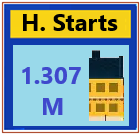
Nov. 17, 2021, at 8:59 a.m. Housing starts edged down 0.7% in October to an annual rate of 1.52 million, the Census Bureau reported on Wednesday. Housing starts edged down 0.7% in October to an annual rate of 1.52 million, the Census Bureau reported on Wednesday.
Building Permits
Analysts had forecast 1.58 million starts, compared to September's revised 1.53 million and 1.6 million permits. Building permits, meanwhile, rose 4% to 1.65 million units annually, up from a revised 1.59 million in September.
Jobless Claims
First-time claims for unemployment insurance were little changed over the past week, indicating the heightened pace of layoffs during the pandemic may have hit a plateau, the Labor Department reported Thursday. Initial filings for the week ended Nov. 13, totaled 268,000, a decline of 1,000 from a week ago and slightly higher than the Dow Jones estimate for 260,000. The total was the lowest since the beginning of the pandemic but in close keeping with where claims have been over the past month. The four-week moving average, which smooths out weekly volatility, declined to 272,750, just a bit above the total for the most recent weekly count. Continuing claims, which run a week behind the headline number, declined by 129,000 to 2.08 million, also a pandemic-era low dating back to March 14, 2020. mm
Empire State Mfg Index
The numbers: The New York Fed's Empire State manufacturing business conditions index rose 11.1 points to 30.9 in November, the regional Fed bank said Monday. Economists had expected a reading of 22, according to a survey by The Wall Street Journal. Any reading above zero indicates improving conditions. The New York Fed's Manufacturing Index for November rose to 30.9 from 19.8 in October, larger than the expected rise to 21.6. The headline was boosted by a rise in the New Orders subindex to 28.8 from 24.3 (a promising sign for manufacturing activity in the coming months), a jump in the Prices Paid subindex to 83.0 from 78.7 and a jump in the Employment subindex to 26.0 from 17.1 (a record high). The only negative spot was a decline in the six-month business conditions subindex to 36.9 from 52. FX markets did not see any notable reaction to the data.
Treasury International Capital (TIC)
The U.S. Department of the Treasury today released Treasury International Capital (TIC) data for September 2021. The next release, which will report on data for October 2021, is scheduled for December 15, 2021. The sum total in September of all net foreign acquisitions of long-term securities, short-term U.S. securities, and banking flows was a net TIC outflow of $26.8 billion. Of this, net foreign private outflows were $22.6 billion, and net foreign official outflows were $4.1 billion. Foreign residents increased their holdings of long-term U.S. securities in September; net purchases were $14.2 billion. Net purchases by private foreign investors were $14.4 billion, while net sales by foreign official institutions were $0.2 billion. U.S. residents decreased their holdings of long-term foreign securities, with net sales of $12.1 billion. Taking into account transactions in both foreign and U.S. securities, net foreign purchases of long-term securities were $26.3 billion. After including adjustments, such as estimates of unrecorded principal payments to foreigners on U.S. asset-backed securities, overall net foreign sales of long-term securities are estimated to have been $1.8 billion in September. Foreign residents increased their holdings of U.S. Treasury bills by $4.7 billion. Foreign resident holdings of all dollar-denominated short-term U.S. securities and other custody liabilities decreased by $43.1 billion.
HMI
Higher prices and longer wait times do not appear to be turning buyers away from the nation’s homebuilders. With demand still surging, homebuilder confidence in the market for single-family homes rose more than expected in November, to the highest level since last May.
Confidence rose 3 points to 83 on the National Association of Home Builders (NAHB)/Wells Fargo Housing Market Index (HMI). Anything above 50 is considered positive. Analyst expectations had been for it to remain unchanged at 80. Sentiment stood at 90 in November 2020.
Industrial Production
US Industrial Production Rebounded 1.6% in October. U.S. industrial production rebounded in October as auto production, which has been hurt by supply chain problems, posted a strong increase and the adverse effects from Hurricane Ida faded. U.S. industrial production rebounded in October as automakers, stung by supply chain problems, posted strong increases and the adverse effects from a hurricane that struck the nation's energy complex in the Gulf of Mexico faded. ndustrial production rose 1.6% last month after a 1.3% plunge in September, the Federal Reserve reported Tuesday. The gain was double what had been expected.
The September weakness reflected severe shortages of semiconductor chips that contributed to a fall in auto production and the lingering impacts of Hurricane Ida which disrupted oil and gas production. The Fed attributed about half of the October gain to recovery from the effects of Ida, which had come ashore in Louisiana on Aug. 29, triggering widespread shutdowns at refineries and chemical plants.
Capacity utilization for the manufacturing sector, a measure of how fully firms are using their resources, increased 0.9 percentage point in October to 76.7%, the highest since January 2019. Overall capacity use for the industrial sector rose to 76.4% from 75.2% in September. It is 3.2 percentage points below its 1972-2020 average..
Philadelphia Fed Manufacturing Index Nov. 2021
A report released by the Federal Reserve Bank of Philadelphia on Thursday showed a significant acceleration in the pace of growth in regional manufacturing activity in the month of November 2021. The Philly Fed said its diffusion index for current activity jumped to 39.0 in November from 23.8 in October, with a positive reading indicating growth. Economists had expected the index to inch up to 24.0. The much bigger than expected increase by the headline index was partly due to a substantial acceleration in the pace of growth in new orders, as the new orders index spiked to 47.4 in November from 30.8 in October. The shipments index also crept up 32.1 in November from 30.0 in October, although the number of employees index slipped to 27.2 from 30.7.
Business Inventories Sep 2021
U.S. business inventories rise solidly in September 2021. Business Inventories up 0.7% in September 2021. The combined value of distributive trade sales and manufacturers’ shipments for September, adjusted for seasonal and trading day differences but not for price changes, was estimated at $1,669.7 billion, up 0.9 percent (±0.2 percent) from August 2021 and was up 15.5 percent (±0.6 percent) from September 2020.. Manufacturers’ and trade inventories for September, adjusted for seasonal and trading day differences but not for price changes, were estimated at an end-of-month level of $2,101.8 billion, up 0.7 percent (±0.2 percent) from August 2021 and were up 7.5 percent (±0.5 percent) from September 2020.
Retail Sales
Retail sales increase 1.7% in October. Core retail sales accelerate 1.6%. Manufacturing production rebounds 1.2%. U.S. retail sales surged in October as Americans eagerly started their holiday shopping early to avoid empty shelves amid shortages of some goods because of the ongoing pandemic, giving the economy a lift at the start of the fourth quarter. The solid report from the Commerce Department on Tuesday suggested high inflation was not yet dampening spending, even as worries about the rising cost of living sent consumer sentiment tumbling to a 10-year low in early November. Rising household wealth, thanks to a strong stock market and house prices, as well as massive savings and wage gains appear to be cushioning consumers against the highest annual inflation in three decades.
Retail sales jumped 1.7% last month, the largest gain since March, after rising 0.8% in September. It was the third straight monthly advance and topped economists' expectations for a 1.4% increase. Sales soared 16.3% year-on-year in October and are 21.4% above their pre-pandemic level.
U.S. Import and Export Price Indexes
U.S. import prices rose 1.2 percent in October 2021 following a 0.4-percent advance in September, the U.S. Bureau of Labor Statistics reported today. Higher fuel and nonfuel prices contributed to the October increase. Prices for U.S. exports advanced 1.5 percent in October 2021, after rising 0.4 percent in September and 0.3 percent in August.
Leading indicators
The Conference Board Leading Economic Index (LEI) for the U.S. increased by 0.9 percent in October 2021 to 118.3 (2016 = 100), following a 0.1 percent increase in September and a 0.7 percent increase in August. The U.S. LEI rose sharply in October suggesting the current economic expansion will continue into 2022 and may even gain some momentum in the final months of this year.Gains were widespread among the leading indicators, with only the average workweek and consumers’ outlook making negative contributions. However, rising prices and supply chain bottlenecks pose challenges to growth and are not expected to dissipate until well into 2022. Despite these headwinds, The Conference Board forecasts growth to remain strong in the fourth quarter at around 5.0 percent (annualized rate), before moderating to a still historically robust rate of 2.6 percent in Q1 2022.
On Thursday, November 18, the Conference Board released it October 2021 report detailing the latest reading for the Leading Economic Index (LEI), a composite of ten data series that tend to lead changes in economic activity. Many economic data points are backward-looking, but we pay special attention to the LEI, as it has a forward-looking tilt to it and spans many segments of the economy. The index grew 0.9% month over month, slightly above the consensus estimate of 0.8% and a strong rebound from September’s 0.1%. One-year growth remains over 9%, advancing for the first time since April and indicating low odds of a recession in the next 6 months.. |