Wholesale Trade (Pre)
Wholesale Trade Sales Down 1.1% in August 2021. Wholesale trade slowed in August, but it was still ahead of revised 2020 levels for the same period, according to the U.S. Census Bureau. Wholesale trade sales dropped 1.1% in August compared to July 2021, but sales were up 20.6% from revised 2020 levels for the same period, according to the latest report from the U.S. Census Bureau. August 2021 sales of merchant wholesalers, except manufacturers’ sales branches and offices, after adjustment for seasonal variations and trading day differences but not for price changes, were $595.5 billion.
Total inventories of merchant wholesalers, except manufacturers’ sales branches and offices, after adjustment for seasonal variations and trading day differences, but not for price changes, were $731.1 billion at the end of August, up 1.2% from the revised July level.
ISM Service - Non Manufacturing Index
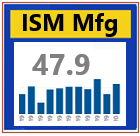
U.S. Services Gauge Edges Up as Business Activity Strengthens. ISM gauge advances slightly to 61.9 in September from 61.7. U.S. service providers expanded at a faster-than-expected pace in September, supported by a pickup in business activity and durable growth in new orders. The Institute for Supply Management’s non-manufacturing index edged up to 61.9 last month from 61.7 in August, data showed Tuesday. The median forecast in a Bloomberg survey of economists called for the measure to fall to 59.9. Readings above 50 signal growth. The report suggests concerns about the delta variant -- though still present -- are abating some as Americans feel more confident spending money on services like dining out and travel. The ISM gauge of business activity among non-manufacturers, which parallels the group’s factory production measure, rose to 62.3 from a six-month low.
Factory Orders
New orders for U.S.-made goods accelerated in August, pointing to sustained strength in manufacturing even as economic growth appeared to have slowed in the third quarter because of shortages of raw materials and labor. The Commerce Department said on Monday that factory orders increased 1.2% in August. Data for July was revised higher to show orders rising 0.7% instead of gaining 0.4% as previously reported. Orders have now increased for four straight months. Economists polled by Reuters had forecast factory orders gaining 1.0%. Orders shot up 18.0% on a year-on-year basis.
ADP Employment Report
Private sector employment increased by 568,000 jobs from August to September according to the September ADP National Employment ReportTM. Broadly distributed to the public each month, free of charge, the ADP National Employment Report is produced by the ADP Research Institute in collaboration with Moody's Analytics. The report, which is derived from ADP's actual data of those who are on a company's payroll, measures the change in total nonfarm private employment each month on a seasonally-adjusted basis.
PMI Composite Final Sep. 2021
September PMI Composite marginally lower from prior level on slower business expansion. Tue, Oct. 05, 2021 for September U.S. PMI Composite Index (Final): 55.0 vs. 54.5 consensus and 55.4 prior. This indicates a slower expansion in private sector business activity; rate of growth was the softest in a year amid slower upturns in both monitored. September PMI Composite Index: 54.3 vs. 54.4 consensus and 54.6 prior. Service: 54.6 vs. 54.6 consensus and 55.0 prior. Business activity rises further amid stronger expansion in new sales. Employment growth remains historically elevated. Selling prices increase at sharpest pace for two years.
US Trade Balance
The U.S. Census Bureau and the U.S. Bureau of Economic Analysis announced today that the goods and services deficit was $73.3 billion in August, up $2.9 billion from $70.3 billion in July, revised.
August 2021 Trade Gap is $73.3 Billion. The U.S. monthly international trade deficit increased in August 2021 according to the U.S. Bureau of Economic Analysis and the U.S. Census Bureau. The deficit increased from $70.3 billion in July (revised) to $73.3 billion in August, as imports increased more than exports. The previously published July deficit was $70.1 billion. The goods deficit increased $1.6 billion in August to $89.4 billion. The services surplus decreased $1.4 billion in August to $16.2 billion..
Consumer Credit
U.S. consumer credit grows in August at the smallest rate in seven months. Total consumer credit increased by $14.4 billion in August, down from a $17.3 billion gain in the prior month, the Federal Reserve said .
Jobless Claims
The Department of Labor said Thursday that jobless claims for the prior week totaled 326,000. That was lower than the 345,000 economists had been calling for. Continuing claims, meanwhile, declined by 97,000 to 2.71 million.
Employment Situation
Nonfarm payrolls increased by 194,000 in September, compared to the Dow Jones estimate for 500,000. The unemployment rate dropped to 4.8%, better than the expected 5.1%. Leisure and hospitality along with professional and business services and retail led job creation. Markets initially reacted little to what was a mixed bag of a report held back by a sharp decline in government jobs. Nonfarm payrolls increased by 194,000 in September, compared to the Dow Jones estimate for 500,000. The unemployment rate dropped to 4.8%, better than the expected 5.1%. Leisure and hospitality along with professional and business services and retail led job creation. Markets initially reacted little to what was a mixed bag of a report held back by a sharp decline in government jobs.
Despite the weak jobs total, wages increased sharply. The monthly gain of 0.6% pushed the year-over-year increase to 4.6% as companies use wage increases to combat the persistent labor shortage. The available workforce declined by 183,000 in September and is 3.1 million shy of where it was in February 2020, just before the pandemic declaration. Despite the weak jobs total, wages increased sharply. The monthly gain of 0.6% pushed the year-over-year increase to 4.6% as companies use wage increases to combat the persistent labor shortage. The available workforce declined by 183,000 in September and is 3.1 million shy of where it was in February 2020, just before the pandemic declaration.
|