Housing Starts
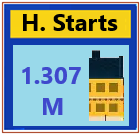
Housing starts fall 7.0% in July. Single-family starts drop 4.5%; multi-family dive 13.1. Building permits rise 2.6%; single-family fall 1.7%. U.S. homebuilding fell more than expected in July, the latest sign that surging construction costs and home prices continued to constrain the housing market early in the third quarter. Though the report from the Commerce Department on Wednesday showed a rebound in building permits after three straight monthly declines, the gain was in the volatile multi-family home segment, which will do little to ease an acute housing shortage that is driving up prices. Housing starts dropped 7.0% to a seasonally adjusted annual rate of 1.534 million units last month. Data for June was revised up to a rate of 1.650 million units from the previously reported 1.643 million units. Economists polled by Reuters had forecast starts would fall to a rate of 1.600 million units.
Building Permits
The number of houses authorized for construction but not yet started last month was the third highest on record, indicating builders remained hesitant to undertake new projects.ermits for future homebuilding rose 2.6% to a rate of 1.635 million units in July. Single-family permits fell 1.7% to a rate of 1.048 million units. They are lagging starts, suggesting a modest rebound in single-family homebuilding. Permits for multi-family housing projects jumped 11.2% to a rate of 587,000 units, reflecting a rebound in demand for rental accommodation as the economy fully reopens.
Treasury International Capital (TIC)
U.S. Department of the Treasury today released Treasury International Capital (TIC) data for June 2021. The next release, which will report on data for July 2021, is scheduled for September 16, 2021. The sum total in June of all net foreign acquisitions of long-term securities, short-term U.S. securities, and banking flows was a net TIC inflow of $31.5 billion. Of this, net foreign private inflows were $69.3 billion, and net foreign official outflows were $37.8 billion. Foreign residents increased their holdings of long-term U.S. securities in June; net purchases were $72.6 billion. Netpurchases by private foreign investors were $80.9 billion, whilenet sales by foreign official institutions were $8.2 billion. U.S. residents decreased their holdings of long-term foreign securities, with net sales of $38.2 billion. Taking into account transactions in both foreign and U.S. securities, net foreign purchases of long-term securities were $110.9 billion. After including adjustments, such as estimates of unrecorded principal payments to foreigners on U.S. asset-backed securities, overall net foreign purchases of long-term securities are estimated to have been $75.8 billion in June. Foreign residents increased their holdings of U.S. Treasury bills by $37.4 billion. Foreign resident holdings of all dollar-denominated short-term U.S. securities and other custody liabilities increased by $37.8 billion. Banks’ own net dollar-denominated liabilities to foreign residents decreased by $82.1 billion.
Housing Market Index - HMI
U.S. homebuilder confidence in the market for single-family homes fell in August to its lowest reading in 13 months, driven by higher construction costs and supply shortages, a report released on Tuesday showed. The NAHB/Wells Fargo Housing Market index declined 5 points to a reading of 75 this month, its lowest level since July 2020, from 80 in July. Economists polled by Reuters had expected the index to remain unchanged from the month prior.
A reading above 50 means more builders view market conditions as favorable than poor. The index hit an all-time high of 90 in November 2020. Surging home prices and limited supply has put a lid on home sales throughout this year. Consequently, fewer U.S. consumers believe that now is a good time to purchase a home.
Empire State Manufacturing Index
The New York Federal Reserve said on Monday its barometer of manufacturing business activity in New York State declined more than expected in August as shipments growth nearly stalled and new orders grew at a much softer pace than a month earlier. The regional Fed's "Empire State" index on current business conditions fell around 25 points to 18.3, lower than a reading of 29.0 forecast by analysts polled by Reuters. The index had hit a record high of 43 in July. A reading above zero signals the New York manufacturing sector is expanding.
Industrial Production
Production at U.S. factories surged in July 2021, boosted by an acceleration in motor vehicle output as automakers either pared or canceled annual retooling shutdowns to work around a global semiconductor shortage.Manufacturing output jumped 1.4% last month after falling 0.3% in June, the Federal Reserve said on Tuesday. Economists polled by Reuters had forecast manufacturing production rising 0.6%. Last month, production at auto plants soared 11.2%. The shortage of semiconductors has forced auto companies to adjust their production schedules. The increase in manufacturing output and a 1.2% rise in mining combined to boost industrial production by 0.9% last month. Industrial output rose 0.2% in June. Mining was driven by higher oil prices, which are supporting drilling activity. Utilities output fell 2.1%. Capacity utilization for the manufacturing sector, a measure of how fully firms are using their resources, increased 1.1 percentage points to 76.6% in July. Overall capacity use for the industrial sector rose 0.7 percentage point to 76.1%. It is 3.5 percentage points below its 1972-2020 average.
The Fed said industrial production advanced by 0.9 percent in July after edging up by a downwardly revised 0.2 percent in June. Economists had expected industrial production to rise by 0.4 percent, matching the increase originally reported for the previous month..
Retail Sales
Retail sales drop worse-than-expected 1.1% in July 2021 as rising Covid fears hit consumers. Retail sales declined 1.1% in July, worse than the expected drop of 0.3%. Motor vehicles and parts dealers led the decline, along with clothing and sporting goods stores. Gasoline sales and eating and drinking establishments saw the biggest gains. Shoppers in the U.S. cut back their purchases in July even more than expected as worries over the delta variant of Covid-19 dampened activity and government stimulus dried up. Retail sales for the month fell 1.1%, worse than the Dow Jones estimate of a 0.3% decline and below the upwardly revised 0.7% increase in June. Excluding automobiles, sales declined 0.4%, according to Commerce Department figures released Tuesday.
Leading Indicators
The Conference Board Leading Economic Index® (LEI) for the U.S. increased by 0.9 percent in July 2021 to 116.0 (2016 = 100), following a 0.5 percent increase in June and a 1.2 percent increase in May. The U.S. LEI registered another large gain in July, with all components contributing positively. The Leading Index’s overall upward trend, which started with the end of the pandemic-induced recession in April 2020, is consistent with strong economic growth in the second half of the year. While the Delta variant and/or rising inflation fears could create headwinds for the US economy in the near term, we expect real GDP growth for 2021 to reach 6.0 percent year-over-year, before easing to a still robust 4.0 percent growth rate for 2022.
Philadelphia Fed Manufacturing Index
Growth in factory activity in the U.S. mid-Atlantic region slowed for the fourth consecutive month in August 2021 after hitting its highest pace in nearly half a century earlier this spring, a survey showed on Thursday. The Philadelphia Federal Reserve Bank said its business activity index fell to 19.4, the lowest since December, from 21.9 in July. That was below economists' expectations for a reading of 23.0, according to a Reuters poll. Any reading above zero indicates expansion in the region's manufacturing. The survey covers factories in eastern Pennsylvania, southern New Jersey and Delaware. It is seen as one of the first monthly indicators of the health of U.S. manufacturing leading up to the national report by the Institute for Supply Management, next due out September 1. Supply constraints have continued to slow manufacturing activity nationwide, indicating that the economics recovery might be slowing down in a year in which growth is projected to accelerate at its fastest pace in nearly four decades. In March, the Philly Fed's factory activity gauge hit its highest level since 1973.
Business Inventories Jun 2021
Inventories in the manufacturing and trade sectors in the United States increased by 0.8% in June 2021 compared to the previous month to stand at $2.06 trillion, according to a report by the US Census Bureau released on Tuesday. The figure was 6.6% higher on a yearly basis. The combined value of distributive trade sales and manufacturers' shipments in June was estimated at $1.64 trillion, rising 1.4% from May and jumping 19.9% year-over-year. The ratio between business inventories and sales was 1.25 at the end of June 2021, down from 1.41 recorded 12 months ago.
FOMC Minutes for Meeting 27-28/Jul/2021
Fed officials saw a path to slowing bond-buying this year, but debated when to start. Minutes from the Federal Reserve’s July 27-28 meeting showed that “most” officials “judged that the standard set out in the committee’s guidance regarding asset purchases could be reached this year.” Federal Reserve officials are preparing to slow the central bank’s large purchases of government-backed bonds, the first step toward a more normal monetary policy setting as the economy heals from the pandemic — but when they met last month, they remained starkly divided over just when the pullback should happen. Minutes from the central bank’s July 27-28 gathering showed that Fed officials generally thought they would soon meet their standard for slowing bond purchases, which they had previously established as “substantial further progress” toward the central bank’s maximum employment and inflation goals.
|