10-Year Treasury Yield
10-year yield punches through key 3%, but there’s a level that could be even scarier for stocks. The closely watched 10-year Treasury yield pushed through the psychological 3% level for the first time since 2018 on Monday, but strategists say there’s another slightly higher level that could be an even bigger test for the stock market.
PMI Manufacturing Final
According to the final version of IHS Markit's April Manufacturing Purchasing Managers Index (PMI) survey, the headline index fell a little to 59.2 versus the flash estimate of 59.7. That suggests that the pace of expansion in US manufacturing remained broadly robust in April. The headlines manufacturing index was 58.8 in March. The final Output Index for April was revised a little higher to 57.6 versus the flash reading of 57.4, while the final Output Prices Index for April was revised a little lower to 76.3 from the flash reading of 78.4, though still sharply higher than March's reading of 69.7.
ISM Manufacturing Index
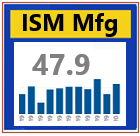
The ISM's index of national factory activity fell to a reading of 55.4 last month, the lowest since a matching reading in September 2020, from 57.1 in March. The last time the index was lower was in July 2020. A reading above 50 indicates expansion in manufacturing, which accounts for 12% of the U.S. economy. Economists polled by Reuters had forecast the index rising to 57.6. The second straight monthly decline in the index also reflects spending rotating back to services like travel, dining out and recreation. Government data on Friday showed consumer spending on services increasing by the most in eight months in March, while outlays on long-lasting manufactured goods dropped for a second consecutive month.
Costruction Spending U.S. construction spending barely rose in March 2022 as a moderate increase in outlays on private projects was partially offset by a further decline in public spending.The Commerce Department said on Monday that construction spending edged up 0.1% after increasing 0.5% in February. Economists polled by Reuters had forecast construction spending would accelerate 0.7%. Construction spending increased 11.7% on a year-on-year basis in March.
FOMC
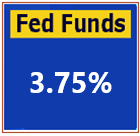
The Federal Reserve is expected to raise interest rates Wednesday for the second time since 2018, boosting the fed funds target rate by a half-percentage point. The central bank is also expected to launch a program to reduce its massive bond holdings by $95 billion a month, starting in June. The markets are braced for a hawkish Fed, but many investors are wondering if Fed Chair Jerome Powell will signal that the central bank is willing to get even tougher with rate increases.
JOLT
Record high U.S. job openings, resignations likely to fuel wage inflation. Job openings increase 205,000 to 11.5 million in March 2022. Hiring falls 95,000 to 6.7 million. Quits rise 152,000 to record 4.5 million. U.S. employers saw record levels of job openings and workers quitting in March 2022, pointing to intensifying labor-market tightness that will keep pushing wages higher at a rapid clip. The number of available positions increased to 11.5 million in March 2022 from 11.3 million in February 2022, the Labor Department’s Job Openings and Labor Turnover Survey, or JOLTS, showed Tuesday. The median forecast in a Bloomberg survey of economists called for 11.2 million openings., Job openings and the level of people quitting their jobs reached records in March 2022. Employment openings exceeded the level of available workers by 5.6 million in March 2022 while a record number of people quit their jobs, the Labor Department reported Tuesday. The level of job postings hit 11.55 million for the month, also a fresh record for data that goes back to December 2000, according to the Job Openings and Labor Turnover Survey. That was up 205,000 from February and representative of a jobs market still historically tight. At the same time, quits totaled 4.54 million, an increase of 152,000 from the previous month as the so-called Great Resignation continued. The pandemic era has seen opportunities for workers who feel confident enough to leave their current situations for better employment elsewhere. A shortage of labor supply during the pandemic has caused a surge in wages, with average hourly earnings up 5.6% from a year ago in March. Still, that hasn’t kept with inflation, which has run at an 8.5% pave over the same time period.
Factory Orders
Rise in U.S. factory orders beats expectations in March 2022. New orders for U.S.-made goods increased more than expected in March and shipments rose solidly, but supply constraints following new COVID-19 lockdowns in China could slow manufacturing activity in the months ahead. The Commerce Department said on Tuesday that factory orders rose 2.2% in March after edging up 0.1% in February. Economists polled by Reuters had forecast factory orders would rise 1.1%.
AMD - Earnings
AMD sales jump 71%, shrugging off concerns about PC slowdown. AMD reported first-quarter earnings after the bell on Tuesday, beating analyst estimates for earnings and revenue, sending the stock up over 3% in extended trading.
Here’s how the chipmaker did versus Refinitiv consensus estimates in the quarter ending March:
EPS: $1.13, adjusted, versus $0.91 expected, up 117% year-over-year
Revenue: $5.89 billion, versus $5.52 billion expected, up 71% year-over-year
MBA Purchase Applications
Weekly mortgage demand rose for the first time since early March last week, but it won’t last. The average contract interest rate for 30-year fixed-rate mortgages with conforming loan balances ($647,200 or less) decreased to 5.36% from 5.37% for loans with a 20% down payment. Refinance applications rose 0.2% for the week but were still 71% lower than a year ago. Mortgage applications to purchase a home rose 4% for the week but were still down 11% year over year. Total mortgage application volume rose 2.5% for the week ended April 29 compared with the previous week, according to the Mortgage Bankers Association’s seasonally adjusted index. That was because mortgage rates took a very slight step back, and the spring housing market entered its historically busiest time. Mortgage applications to purchase a home rose 4% for the week but were still down 11% year over year. Homebuyers are now turning more to adjustable-rate mortgages which offer a substantially lower interest rate and can be fixed rate for up to 10 years. The ARM share of activity remained unchanged at 9.3% of total applications, but that is more than twice the share it was a year ago.
International Trade in Goods and Services
U.S. trade deficit expanded by 22.3% to a record $109.8 billion in March 2022. Strong U.S. demand for computers, vehicles and oil helped drive the U.S. trade deficit to a new record of $109.8 billion in March. The Commerce Department on Wednesday said the trade deficit widened by 22.3% from the prior month. The U.S. trade deficit surged to a record high in March, confirming that trade weighed on the economy in the first quarter and could remain a drag for a while as businesses replenish inventories with imported goods. The Commerce Department said on Wednesday that the trade deficit accelerated 22.3% to $109.8 billion in March amid a record increase in imports. Economists polled by Reuters had forecast a $107 billion deficit.
Trade from GDP
The government reported last week that a record trade deficit sliced 3.20 percentage points from gross domestic product in the first quarter, resulting in GDP contracting at a 1.4% annualized rate after growing at a robust 6.9% pace in the fourth quarter. Trade has subtracted from GDP for seven straight quarters. Imports of goods and services jumped 10.3% to $351.5 billion, outpacing a 5.6% rise in exports to $241.7 billion.
ADP Employment Report
Private payrolls increased by 247,000 in April 2022, well below the estimate, ADP says. Private payrolls increased by just 247,000 for April, payrolls processing firm ADP reported. That was well below the estimate for 390,000 and a significant decline from March, which saw an upwardly revised gain of 479,000. The report serves as a precursor to Friday’s nonfarm payrolls count, though the two can differ by wide margins. Companies added far fewer jobs than expected in April as the struggle to find workers to fill open positions continued, payrolls processing firm ADP reported Wednesday. Private payrolls increased by just 247,000 for the month, well below the 390,000 Dow Jones estimate. That was a big decline from March, which saw an upwardly revised gain of 479,000. A drop-off in small business hiring was the primary culprit for the disappointment, as companies with fewer than 50 workers saw a decline of 120,000. The issue was particularly acute in those with fewer than 20 employees, which lost 96,000 workers on the month.
Mortgage Rates
The average contract interest rate for 30-year fixed-rate mortgages with conforming loan balances ($647,200 or less) decreased to 5.36% from 5.37%, with points falling to 0.63 from 0.67 (including the origination fee) for loans with a 20% down payment. That rate was 218 basis points lower the same week one year ago. Rates shot significantly higher at the start of this week.
PMI Composite Final
PMI Composite Final comes in higher from consensus and lower M/M. April PMI Composite Final: 56.0 vs. 55.1 consensus vs. 57.7 prior. The rate of output growth eased to the slowest for three months, but was sharp overall. Input and labor shortages pushed up cost burdens to the greatest extent on record. New export orders rose at the quickest rate since data collection for the respective seasonally adjusted series began in September 2014. Service PMI: 55.6 vs. 54.7 consensus vs. 58.0 prior. Higher wage, transportation and material costs drove up input prices. The rate of input price inflation accelerated for the third successive month to the fastest in 11-and-a-half years of data collection. Backlogs of continued to rise, thereby extending the current sequence of expansion that began in July 2020.
ISM Non-Mfg Index
ISM Non-Manufacturing Index slipped to 57.1% in April 2022. Economic activity in the services sector grew in April for the 23rd month in a row — with the Services PMI® registering 57.1 percent — say the nation’s purchasing and supply executives in the latest Services ISM® Report On Business®. The report was issued today by Anthony Nieves, CPSM, C.P.M., A.P.P., CFPM, Chair of the Institute for Supply Management® (ISM®) Services Business Survey Committee: “In April, the Services PMI® registered 57.1 percent, 1.2 percentage points lower than March’s reading of 58.3 percent. The Business Activity Index registered 59.1 percent, an increase of 3.6 percentage points compared to the reading of 55.5 percent in March, and the New Orders Index figure of 54.6 percent is 5.5 percentage points lower than the March reading of 60.1 percent.
FOMC Meeting#3 Announcement
Fed raises rates by half a percentage point — the biggest hike in two decades — to fight inflation. The Federal Reserve increased its benchmark interest rate by half a percentage point, in line with market expectations. In addition, the central bank outlined a program in which it eventually will reduce its bond holdings by $95 billion a month. The rate move is the largest since 2000 and is in response to burgeoning inflation pressures. Fed Chairman Jerome Powell underlined the commitment to bringing inflation down but indicated that raising rates by 75 basis points at a time “is not something the committee is actively considering.”
Jobless Claims
The numbers: Initial jobless claims rose by 19,000 to 200,000 in the week ended April 30, the Labor Department said Thursday. This is the biggest weekly rise in claims since last July and the highest level since mid-February.
Productivity and Cost
U.S. Productivity Drops Most Since 1947, Driving Up Labor Costs. Output per hour slumped an annualized 7.5% in first quarter. Unit labor costs post largest annual increase since 1982. U.S. productivity dropped in the first quarter by the most since 1947 as the economy shrank, while labor costs surged and illustrated an extremely tight job market. Productivity, or nonfarm business employee output per hour, decreased at a 7.5% annual rate from the previous three months, according to Labor Department figures Thursday. That compared to a 6.3% gain in the fourth quarter and the 5.3% projected decline in a Bloomberg survey of economists.
Employment Situation
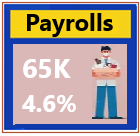
Employment Report Shows Continued Solid Job Growth. Today's jobs report showed further job gains in April, following months of solid growth in the first quarter of 2022. The labor market continues to expand, especially in in-person services and in other industries that have yet to fully recover job losses incurred since the pandemic. Severe labor shortages continue to drive up wages, adding additional pressure on inflation. The labor market remains strong while the Federal Reserve maintains its focus on stabilizing prices with increasing interest rates and a commitment to shrinking their asset portfolio. Nonfarm payroll employment increased by 428,000 in April, after a slight downwardly revised increase of 428,000 in March. The labor force participation rate decreased slightly to 62.2 percent, compared to 62.4 percent in March, while the unemployment rate remained unchanged at 3.6 percent. Overall, employment is still down 0.8 percent compared to pre-pandemic (February 2020) levels, representing 1.2 million jobs. Job recovery has been slower for women, with employment still 1.1 percent below pre-pandemic levels, compared to 0.5 percent for men.Average hourly earnings rose 5.5 percent over the past 12 months, with an 11.0 percent increase in leisure and hospitality and a 7.1 percent increase in transportation and warehousing. Wages will continue to rise steadily, especially in industries most impacted by labor shortages.
Consumer Credit
While it is traditionally viewed as a B-grade indicator, the March 2022 consumer credit report from the Federal Reserve was an absolute shocked and confirmed what we have been saying for month: any excess savings accumulated by the US middle class are long gone, and in their place Americans have unleashed a credit-card fueled spending spree. Here are the shocking numbers: in March 2022, one month after the February print already came in more than double the $18 billion expected, consumer credit exploded to an absolutely blowout $52.435 billion, again more than double the expected $25 billion print, and the highest on record. Consumer debt levels for March 2022 climbed by $52.4 billion, an annual increase of 14%, seasonally adjusted, according to Federal Reserve data released Friday. Revolving credit, which includes credit cards, surged by 21.4%. Despite robust wage growth -- over the past 12 months, average hourly earnings have gone up by 5.5% -- consumers are seeing those gains eroded by the highest inflation in 40 years. The cost of food is up nearly 9% over the last year, and a gallon of gas now averages $4.279 at the pump. Paying off credit card debt is about to get even more difficult for those who don't make the minimum monthly payment: The Federal Reserve on Wednesday announced a half-point rate hike as part of a series of actions intended to address rampant inflation. That means interest rates will rise on everything from credit cards to car loans, pressuring household budgets even further.
|