Presidents' Day - Holiday
The third Monday in February is set aside to commemorate the birthdays of two great American presidents, both born in this month: Abraham Lincoln on the 12th and George Washington on the 22nd. It is a legal holiday.
US Dollar Index
mmmm
10-Year Treasury Yield
mmmm
Empire State Mfg Index
Monthly manufacturing data from the Empire State survey swings to a positive this morning, +5.7 versus -1.0 expected, for the fifth positive month in the past seven. This is a nice bounce-back from the unrevised -12.6 reported for January. November had the strongest monthly number in the past year, +20.2; April had the weakest: -19.4. Manufacturing activity edged higher in New York State, according to the Empire State Manufacturing February survey. The diffusion index for General Business Conditions climbed 18.3 points to 5.7. The latest reading was better than the forecast of -1.9. Empire State Manufacturing Survey: Activity Edged Higher In February 2025.
Housing Market Index
Later this morning, the Homebuilder Confidence survey for February hits the tape. It’s expected to tick down to 46 from 47 reported the prior month, which was the strongest since April of last year. August was the low point of the past 12 months, at 39. Considering that mortgage rates are not expected to sink down to more comfortable levels in the near term, we’d have to say homebuilder confidence is hanging in there. We’ll see what the results are today.
Treasury Intal Capital
mmmm
Crypto World
Bitcoin and crypto prices have flat-lined over the last week as traders await an “important” announcement from Donald Trump's U.S. administration. The bitcoin price is stuck under $100,000 per bitcoin after rocking past the closely-watched level in the aftermath of Trump’s election victory (even as Wall Street giant Goldman Sacks reveals it’s betting on bitcoin). Now, as Tesla billionaire Elon Musk raises questions over the U.S. gold reserve, influential bitcoin company executive Samson Mow has warned of "price suppression" as bitcoin nears a so-called “death cross.”
MBA Mortgage Applications
Weekly mortgage demand drops 6%, as homebuyers remain ‘on the fence’. The average contract interest rate for 30-year fixed-rate mortgages with conforming loan balances ($766,550 or less) decreased to 6.93% from 6.95%Applications to refinance a home loan dropped 7% for the week but were 39% higher than the same week one year ago. Applications for a mortgage to buy a home fell 6% for the week but were 7% higher year over year.The average contract interest rate for 30-year fixed-rate mortgages with conforming loan balances ($766,550 or less) dropped to 6.93% from 6.95%, with points increasing to 0.66 from 0.64 (including the origination fee) for loans with a 20% down payment. Applications to refinance a home loan, which had been on the rise, dropped 7% for the week but were 39% higher than the same week one year ago. Percentage changes week to week have been large simply because the overall volume of refinancing is so low. The vast majority of borrowers today have mortgages with rates significantly lower than what is now being offered
Housing Starts
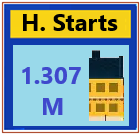
U.S. single-family homebuilding fell sharply in January amid disruptions from snowstorms and freezing temperatures, with a rebound likely to be limited by higher costs from tariffs on imports and elevated mortgage rates.The report from the Commerce Department on Wednesday mirrored similar weather distortions that impacted retail sales and job growth last month, and suggested that economic activity slowed early in the first quarter. Part of the decline in housing starts was normalization following outsized increases in November and December amid recovery from Hurricane Helene. Single-family housing starts, which account for the bulk of homebuilding, dropped 8.4% to a seasonally adjusted annual rate of 993,000 units last month, the Commerce Department's Census Bureau said. Data for December was revised higher to show homebuilding increasing to a rate of 1.084 million units from the previously reported pace of 1.050 million units. New residential construction decreased 9.8% to an annualized pace of 1.37 million last month, slipping after a nearly 16% surge in December, according to government data released Wednesday. That trailed the median estimate of economists surveyed by Bloomberg, who expected an annualized 1.39 million pace.
Building Permits
A small improvement in permits suggests the drop in ground-breakings largely was owed to adverse weather. However, a broad-based pullback in home builder confidence during February is a reminder of the challenging road ahead for single-family construction. On top of high interest rates and elevated inventory levels, new trade and immigration policies stand to reintroduce supply chain uncertainty and constrain new production.
E-Commerce Retail Sales
mmmmm
FOMC Minutes
Fed officials are worried about tariffs’ impact on inflation and see rate cuts on hold, minutes show. Federal Reserve officials in January agreed they would need to see inflation come down more before lowering interest rates further, and expressed concern about the impact President Donald Trump’s tariffs would have in making that happen, according to meeting minutes released Wednesday. Policymakers on the Federal Open Market Committee unanimously decided at the meeting to hold their key policy rate steady after three consecutive cuts totaling a full percentage point in 2024. The Fed’s benchmark overnight borrowing rate is currently targeted between 4.25%-4.5%.after Fed minutes offer no surprises.
The Fed left its benchmark overnight interest rate unchanged in the 4.25%-4.50% range last month, having reduced it by 100 basis points since September, when it embarked on its policy easing cycle. The policy rate was hiked by 5.25 percentage points in 2022 and 2023 to tame inflation.
Hedging Gold
mmmmm
Jobless Claims
The number of Americans filing new applications for unemployment benefits increased moderately last week, suggesting that the labor market remained on solid ground in February. Initial claims for state unemployment benefits rose 5,000 to a seasonally adjusted 219,000 for the week ended February 15. Economists polled by Reuters had forecast 215,000 claims for the latest week. Claims have been bouncing in the 203,000-223,000 range so far this year. Historically low layoffs are keeping the labor market stable, but that could change as workers dependent on federal government contracts or funding lose their jobs.
Philadelphia Fed Mfg Index
A survey from the Philadelphia Fed on Thursday showed its measures of prices paid for inputs and received for products by factories in the Mid-Atlantic region increased to their highest levels in over two years in February. The business activity index fell sharply.
Leading Economic Index
The Conference Board Leading Economic Index® (LEI) for the US fell by 0.3% in January 2025 to 101.5 (2016=100), after a 0.1% increase in December 2024 (upwardly revised from an initially estimated decline of 0.1%). Overall, the LEI recorded a 0.9% decline in the six-month period ending January 2025, much less than its 1.7% decline over the previous six months. The US LEI declined in January, reversing most of the gains from the previous two months.
Commodities - Oil
mmmmm
Fed Balance Sheet
Level $6.853 T. Total Assets -W/W $-33.472 B. Reserve Bank Credit - W/W $-20.940 B.
Mortgage Rates
mmmmm
PMI Manufacturing Flash
mmmmmm
Exisitng Home
Sales
US existing home sales fall more than expected in January 2025. U.S. existing home sales dropped more than expected in January after three straight monthly increases as high mortgage rates and house prices stifled demand. Home sales decreased 4.9% last month to a seasonally adjusted annual rate of 4.08 million units, the National Association of Realtors said on Friday. Economists polled by Reuters had forecast home resales slipping to a rate of 4.12 million units.
Michigan Consumer Sentiment
The University of Michigan consumer sentiment index fell to 64.7 in January, a decline of 10% and a steeper drop than expected as consumers feared higher inflation ahead. The 5-year inflation outlook in the survey was 3.5%, the highest since 1995. Stocks pulled back on Friday, as a mix of weak consumer sentiment data and a decline in UnitedHealth stock added further pressure to what has been a rocky week for Wall Street. The headline consumer sentiment index plunged to 64.7, down 9.8% from January and below the Dow Jones estimate for 67.8. The level also was 15.9% below the same level a year ago. The indexes for current conditions and forward expectations also slumped, according to the report, which was the final revision for the month’s data. On inflation, the one-year expectation leaped to 4.3%, the highest since November 2023.
S&P 500 Index - Week Performance
Open 2025 at 5,903.26 and close at 5,942.47. Positive 0.83%
Geopolitical Risk
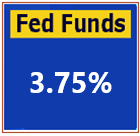
Trading in 30-day fed funds futures contracts Friday now suggests roughly 55% odds that the Federal Reserve will cut rates two to three times by the end of the year, to a range of 3.50% to 3.75% from 4.25% to 4.50% today.
mmm
|