U.S. Markit Manufacturing PMI Index
US: Markit Manufacturing PMI rises to 59.2 (final) in January from 57.1. Markit Manufacturing PMI in US continued to rise in January. US Dollar Index clings to strong gains a little below 91.00. The IHS Markit's Manufacturing PMI for the US rose to 59.2 (final) in January from 57.1 in December to show an ongoing expansion in the manufacturing sector's economic activity at a strengthening pace. This reading came in slightly higher than the flash estimate and the market expectation of 59.1.
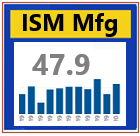
ISM Manufacturing PMI at 58.7%
Economic activity in the manufacturing sector grew in January, with the overall economy notching an eighth consecutive month of growth, say the nation's supply executives in the latest Manufacturing ISM Report On Business.
The January Manufacturing PMI registered 58.7 percent, down 1.8 percentage points from the seasonally adjusted December reading of 60.5 percent. This figure indicates expansion in the overall economy for the eighth month in a row after contraction in March, April, and May. The New Orders Index registered 61.1 percent, down 6.4 percentage points from the seasonally adjusted December reading of 67.5 percent. The Production Index registered 60.7 percent, a decrease of 4 percentage points compared to the seasonally adjusted December reading of 64.7 percent.
December Construction Spending Up 5.7% Year-Over-Year
Despite the pandemic, construction spending for 2020 wound up at $1,429.7 billion, up 4.7% from 2019.
Construction spending during December 2020 was estimated at a seasonally adjusted annual rate of $1,490.4 billion, 5.7% above the December 2019 estimate of $1,410.3 billion and 1% above the revised November estimate of $1,475.6 billion, according to the U.S. Census Bureau.
Mortgage refinancing suddenly surges, but homebuyers stall due to sticker shock
The average contract interest rate for 30-year fixed-rate mortgages decreased last week to 2.92% from 2.95%.
The Mortgage Bankers Association’s refinance index hit its highest level since March.
Mortgage applications to purchase a home were essentially flat for the week, rising just 0.1%.
ADP Employment Report
ADP Private sector of U.S. economy adds 174,000 jobs in Jan.; Dec. loss was 78,000
Private firms added 174,000 jobs in January, well above the 50,000 Dow Jones estimate, according to ADP. The biggest gains came from health care and social assistance and professional and business services. Leisure and hospitality added 35,000 for the month but remains well below pre-pandemic levels.
ISM Service Index - Non Manufacturing
Services PMI at 58.7%; January 2021 Services ISM Report On Business. In January, the Services PMI registered 58.7 percent, 1 percentage point higher than seasonally adjusted December figure of 57.7 percent. This reading indicates the services sector grew for the eighth consecutive month after two months of contraction and 122 months of growth before that.
PMI Composite Final
January PMI Composite final print rises sharply on stronger client demand. Wed, Feb. 03, 2021.
January U.S. PMI Composite Index (Final): 51.1 vs. 50.8 consensus and 57.0 prior.The upturn was the slowest since July 2020 as manufacturers and service providers registered a considerable slowdown in growth momentum.The expansion in new business also softened, but remained solid overall. Cost pressures eased in January, as the pace of input price inflation softened to the slowest since March 2021. The rate of output charge inflation, however, was broadly unchanged from December, and marked overall.
Service Index: 51.2 vs. 50.9 consensus, 57.6 prior, but up slightly on the earlier released 'flash' figure of 50.9.
Jobless claims better than expected last week and lowest in two months
Weekly jobless claims came in a bit less than expected last week though U.S. employment gains remain sluggish.
First-time claims for unemployment insurance totaled 779,000 for the week ended Jan. 30, the Labor Department reported Thursday. That was below the 830,000 estimate from economists surveyed by Dow Jones.
This was the lowest week for claims since Nov. 28 as the U.S. economy continues its slow recovery from the Covid-19 pandemic.
Factory Orders
U.S. Factory Orders Climb 1.1% in December. Manufacturing has been driven by strong demand for factory goods "as 23.7% of the labor force works from home because of the COVID-19 pandemic.
Employment Situation
The economy gained just 49,000 jobs in January 2021 as recovery sputters amid pressure from virus. The U.S. gained back a paltry 49,000 jobs in January, a sign that the economic recovery may be faltering under ongoing pressure from the coronavirus. The unemployment rate fell to 6.3 percent from 6.7 percent in December, but that decline was driven by more than 400,000 people who left the workforce instead of getting jobs.
The January data, released by the Bureau of Labor Statistics, is another reminder of how much ground the labor market still needs to regain to return to pre-pandemic levels.
The U.S. now has more than 9.8 million fewer jobs than it did in February 2020, recovering less than half of what was lost during the early days of the pandemic.
At the anemic rate of growth in January, it would take more than 16 years to regain all of those jobs.The economy added a meager 49,000 jobs in January and the unemployment rate fell to 6.3 percent as the size of the labor force shrank, signaling the ongoing fragility of the recovery. Economists had expected 50,000 jobs to be added and the jobless rate to remain unchanged.
January's report, the first monthly release under President Joe Biden, is an improvement from December, which saw a reversal of 227,000 jobs. However, it does not even capture the millions of people economists estimate have dropped out of the labor force and are no longer looking for work. Nearly 18 million Americans continue to receive unemployment benefits of some kind.
..
U.S. Trade Balance - Goods and Services
December 2020 Trade Gap is $66.6 Billion. The U.S. monthly international trade deficit decreased in December 2020 according to the U.S. Bureau of Economic Analysis and the U.S. Census Bureau. The deficit decreased from $69.0 billion in November (revised) to $66.6 billion in December, as exports increased more than imports. The previously published November deficit was $68.1 billion. The goods deficit decreased $2.8 billion in December to $84.2 billion. The services surplus decreased $0.4 billion in December to $17.5 billion.
Exports and imports in December 2020 reflect both the ongoing impact of the COVID-19 pandemic and the continued economic recovery from the sharp declines earlier in the year. The full economic effects of the pandemic cannot be quantified in the trade statistics because the impacts are generally embedded in source data and cannot be separately identified.
Earnings
Amazon.com (AMZN) – CEO Jeff Bezos is stepping down from that role to become executive chairman, and will be replaced by Amazon Web Services chief Andy Jassy. Separately, Amazon reported quarterly earnings of $14.09 per share, well above the consensus estimate of $7.23. Revenue also topped forecasts and exceeded $100 billion for the first time, helped by a surge in online shopping during the holiday season. The shares were up 2% in premarket trading as of 7:32 a.m. ET.
Amazon.com reported fourth-quarter 2020 earnings of $14.09 per share, beating the Zacks Consensus Estimate by 99.8%. The bottom line also improved 117.8% from the year-ago quarter and 13.9% from the previous quarter. Net sales of $125.6 billion comfortably surpassed the Zacks Consensus Estimate of $120.4 billion and exceeded management’s guidance of $112-$121 billion. Further, the figure increased 44% on a year-over-year basis and 30.6% sequentially.
Alphabet (GOOGL) – Alphabet earned $22.30 per share for its latest quarter, compared to a consensus estimate of $15.90 a share. The Google parent’s revenue beat estimates as well. Alphabet reported strong results for ad sales, although it saw losses in its cloud division as it broke out figures separately for that unit for the first time. The stock popped 7% in premarket trading as of 7:32 a.m. ET.
Boeing (BA) – Boeing reported a quarterly loss of $15.25 per share, which included $8.3 billion in charges relating to the 737 Max and a delay in the 777-X program, among other factors. Boeing’s revenue came in above Wall Street forecasts. Separately, EU regulators have cleared the MAX for a return to service in Europe. Boeing shares slipped 2.4% in premarket trading as of 7:49 a.m. ET.
Microsoft (MSFT) – Microsoft earned $2.03 per share for its latest quarter, beating the consensus estimate of $1.64 a share. Revenue topped estimates as well. Microsoft’s Azure cloud computing unit had a particularly strong quarter, with revenue rising 50% from a year earlier. Shares rose 1.16% in the premarket.
Amazon
Amazon reports first $100 billion quarter following holiday and pandemic shopping surge. TECH
The announcement came in Amazon’s earnings report for the fourth quarter of 2020, in which it delivered its largest quarter by revenue of all time, generating $125.56 billion in sales. Amazon announced in its earnings report for the fourth quarter of 2020 that Amazon Web Services CEO Andy Jassy will replace Jeff Bezos as Amazon CEO during the third quarter of this year. Bezos will become executive chairman. The company also delivered its largest quarter by revenue of all time at $125.56 billion, pushing it past the symbolic $100 billion mark for the first time. Shares of Amazon were up 1% in extended trading. Here are the results: Earnings: $14.09 vs $7.23 per share forecast by Refinitiv Revenue: $125.56 billion vs $119.7 billion forecast by Refinitiv.
Productivity and Cost
In the fourth quarter 2020, productivity slumped -4.8%. Productivity rates can be extremely volatile. Unit labor Costs increase 6.8% and the estimate was 3.1%.
Consumer Credit for Dec 2020
U.S. consumers increased their borrowing in December by $9.7 billion, as Americans took out loans to buy autos or finance their educations. But credit card use declined for the third-consecutive month. The rise in total borrowing in December was down from a gain of $13.9 billion in November, the Federal Reserve reported Friday. The slowdown came as the category that includes credit cards fell by $2.95 billion in December. That category has been up only two months over the past year as households eased off their use of their cards in the midst of a pandemic-induced recession. |