China Number 1
In the case of China, one of the greatest contributors to the U.S. indebtedness to China is the fact that the U.S. purchases far more goods from China than China purchases from the U.S.
Demand in the U.S. for Chinese goods outweighs demand for U.S. goods in China by nearly 500%, according to the "Washington Post." With fewer goods to return in kind and a falling dollar, the U.S. has, in essence, been buying Chinese goods on credit. Also contributing to the amount of U.S. debt that China holds is the amount of money that the U.S. borrows from China to raise capital for other government spending.
Bond as Safe Investement
Historically, buying U.S. government bonds has been a safe investment, since the risks of the U.S. defaulting on the loan have been very low, while the chances of the dollar increasing in value have been high. As the U.S. hits rough patches in its economy--such as the subprime mortgage crisis--and needs to raise money in an attempt to steady the turbulent market (the massive bailout of investment banks and financial services companies, for example), it can turn to other nations for extra spending power. This stimulates the consumer economy, because loans and mortgages underwritten by foreign investors result in lower interest rates and more flexible credit terms
China Owning Debt
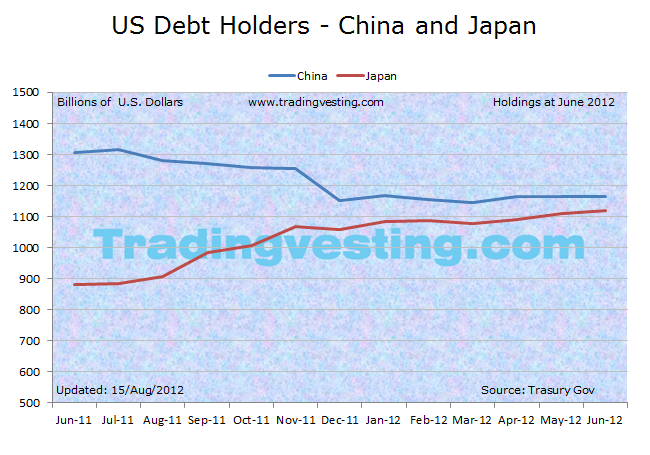
China owned $800.5 billion in U.S. Treasurys. That's up $24.1 billion, or 3%, from the prior month and follows a slight dip in China's holdings from May to June.
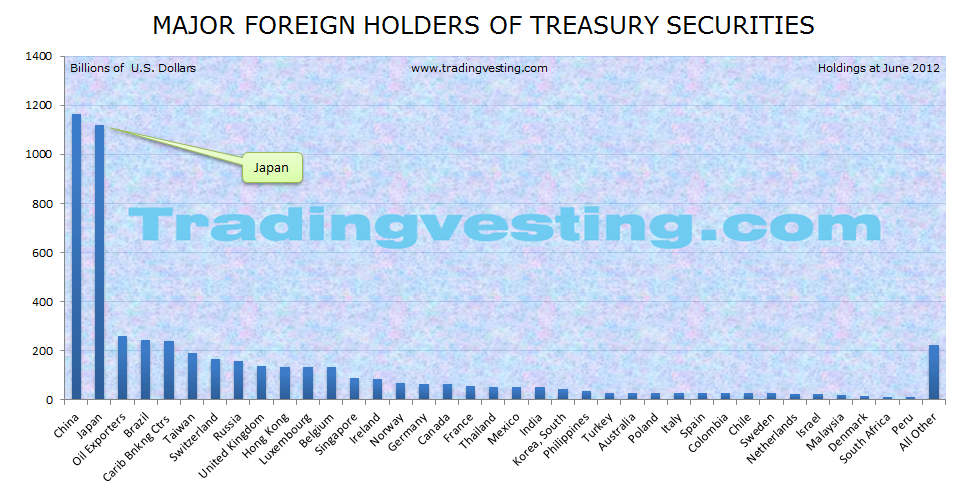
China surpassed Japan as the largest holder of Treasury securities in September 2008, and over the past year, it has increased its stake in U.S. debt by 45%
The fact that China is the largest foreign owner of U.S. Treasurys does put them in a powerful position. With over $800 billion in Treasury holdings, China obviously has a lot of leverage to try and sway U.S. monetary, fiscal and trade policy. That partly explains their concerns about our deficit and the recent uproar over the tire tariffs.
Types of Debt
There are all kinds of debt'as small as personal debt or as large as national debt. There's another type of debt as important as the rest called Sovereign Debt.
What is sovereign debt?
It's debt guaranteed by a particular government, often called external debt.
What happens is this: In order to raise money, a government will issue bonds in a currency that is not the government's and sells those bonds to foreign investors.
This is what makes the debt external, as purchasers are from outside the country.
The currency chosen for the sovereign debt is usually a strong one, in that its value is higher than other currencies.
Bonds, of course, are instruments of debt to be paid back at a certain time that can be as long as ten years or as short as one year with the original investment plus interest. Bonds issued by a government in a foreign currency are called sovereign bonds.
The money collected by the sale of the bonds can be used in any manner the issuing government wants. For instance, the funds can be used to spur job growth with spending on infrastructure projects. A government could also give the money to private companies or banks.
It's important to note, sovereign debt is technically owed by a government and not the citizens of the country issuing the sovereign bonds. It's not the national debt .
However, in order to pay the sovereign debts, the government has to come up with the money in the foreign currency in which it sold the bonds. To get that money, the country could divert funds from internal spending, increase taxes, and/or induce cutbacks in social programs such as pensions.
What happens if a country defaults on its sovereign debt?
Risk that a country may not be able to pay the foreign investors who bought sovereign bonds is an issue because it has happened. Recent examples are Russia, which defaulted on its sovereign debt in 1998, and Argentina in 2002.
This usually happens when a new government takes power and refuses to pay the sovereign debt, or simply when the country does not have the money to pay when the debt is due.
In most cases, the only recourse for the lender is to renegotiate the terms of the loan it cannot seize the government's assets. When a country is unable to pay its sovereign debt, the loans are rescheduled for later payment or restructured at better interest rates for the country owing the debt.
Nevertheless, a default would hurt a country's chances of obtaining a loan in the future. Its credit rating would also be hurt, making it more expensive for the country to sell sovereign debt bonds in the future.
Also, investors might not want to invest in a country that's not able to pay its sovereign debt, leaving the country with fewer funds for economic growth.
Sovereign debt defaults can send stock and bond markets around the world into a frenzy. Confidence in the markets can suffer when a country defaults, depending on the size of the default. Investors don't get their money back or have to take reduced rates on their investments. Often, the countries that own the debt might pledge funds to help the debt-ridden country survive any type of economic collapse.
What is the history of sovereign debt defaults?
Sovereign debt has been around for a long time and so have defaults. Portugal has defaulted four times on its external debt obligations since the late 1800s. So far, Greece has defaulted five times in the same time span.
Spain has defaulted six times, with the last occurrence in the 1870s. We mentioned recent examples of Russia and Argentina above.
However, there are a number of countries that have clean records of paying on sovereign debt obligations and have never defaulted. These include the U.S., Canada, Denmark, Belgium, Finland, Malaysia, Mauritius, New Zealand, Norway, Singapore, Switzerland and England. |