| Where is the money spent that is borrowed from the public and who decides where it goes?
The Bureau of Public Debt is responsible for accounting for and reporting the debt in accordance with statutory direction. The Bureau does not have any public policy decision-making authority.
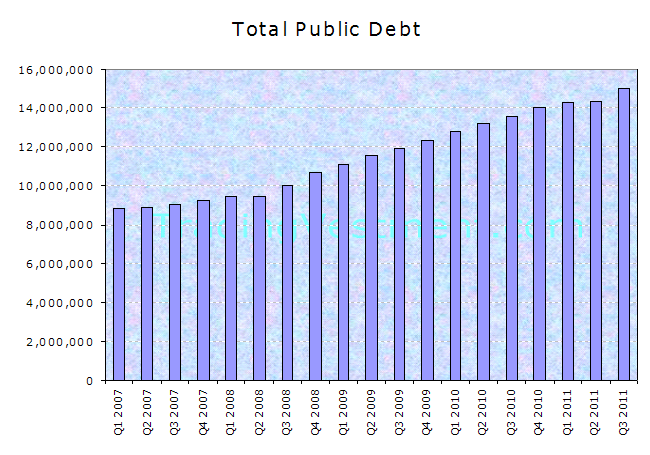
If our GDP is $14 trillion or so, it would take us over 2 years of full U.S. productivity to pay off this debt. That will never happen because we are spending along the way. This is like a household making $30,000 a year needing to pay off a $3 million loan. As long as the monthly payment is low, not a big deal right? But we will be paying this stuff off for centuries.
What is the difference between the debt and the deficit?
The Budget deficit is the fiscal year difference between what the United States Government takes in from taxes and other revenues, called receipts, and the amount of money the Government spends, called outlays. The items included in the deficit are considered either on-budget or off-budget.
You can think of the total debt as accumulated deficits plus accumulated off-budget surpluses. The on-budget deficits require the U.S. Treasury to borrow money to raise cash needed to keep the Government operating. We borrow the money by selling securities like Treasury bills, notes, bonds and savings bonds to the public.
The Treasury securities issued to the public and to the Government Trust Funds (Intragovernmental Holdings) then become part of the total debt.
What's the difference between the Public Debt Outstanding and the Public Debt Subject to Limit?
The Public Debt Outstanding represents the face amount or principal amount of marketable and non-marketable securities currently outstanding. The Public Debt Subject to Limit is the maximum amount of money the Government is allowed to borrow without receiving additional authority from Congress.
Why does the debt only change once a day? Why doesn't Treasury keep a rolling tab?
Our current accounting system produces the Public Debt Outstanding amount daily. Our system relies on reporting entities (for example, Federal Reserve Banks) to report a variety of Treasury security information at the end of the day. On the following business day, our accounting system processes this information and generates the Public Debt Outstanding for the previous day which is posted to our website by 3 PM.
Although we continually look for methods to improve our process, daily accounting is still the most effective, efficient, and accurate way to account for the debt.
The federal debt ceiling is $14.294 trillion, set to be reached by Aug. 2 if Congress and the president don't reach a deal to extend it.
As of the most recent accounting, however, the United States has $14.343 trillion in debt $48.9 billion more than the debt limit. That's because Congress, over the years, has exempted certain kinds of debt from the ceiling.
One such category: old debt. When Congress first established a debt limit as part of the World War I-era Second Liberty Bond Act of 1917, the limit applied only to new debt. Ninety-four years later, the government still owes $55,757 from its first bond issue in 1790, which was used to pay off the states' Revolutionary War debt.
Who owns the debt?
For the most part, the U.S. debt is owed to its own citizens. However, as U.S. expenses grow, the government increasingly turns to other nations to raise capital. This results in external debt. China became the largest foreign creditor to the U.S. in November 2008.
What is the Debt Held by the Public?
The Debt Held by the Public is all federal debt held by individuals, corporations, state or local governments, foreign governments, and other entities outside the United States Government less Federal Financing Bank securities. Types of securities held by the public include, but are not limited to, Treasury Bills, Notes, Bonds, TIPS, United States Savings Bonds, and State and Local Government Series securities.
Public debt is incurred in the U.S. when individuals buy government bonds. A government bond is essentially a loan to the U.S. government. These are advantageous to the bond holder because the value increases according to interest rates, resulting in a profit when the bonds are redeemed. Meanwhile, the government has increased spending power (i.e., leverage). For the most part, the U.S. debt is owed to its own citizens. However, as U.S. expenses grow, the government increasingly turns to other nations to raise capital. This results in external debt.
What are Intragovernmental Holdings?
Intragovernmental Holdings are Government Account Series securities held by Government trust funds, revolving funds, and special funds; and Federal Financing Bank securities. A small amount of marketable securities are held by government accounts.
What is the Federal Financing Bank?
Obligations are issued to the public by the Federal Financing Bank (FFB) to finance its operations. Obligations are limited to $15 billion unless otherwise authorized by the Appropriations Acts. The FFB was established "to consolidate and reduce the government's cost of financing a variety of federal agencies and other borrowers whose obligations are guaranteed by the federal government." (The First Boston Corporation, The Pink Book: Handbook of U.S. Government & Federal Agency Securities, 34th ed., Probus, Chicago, 1990 pp. 87-88.)
Financing the Debt
-
Why does the debt sometimes decrease?
The Public Debt Outstanding decreases when there are more redemptions of Treasury securities than there are issues.
Public debt is incurred in the U.S. when individuals buy government bonds. A government bond is essentially a loan to the U.S. government. These are advantageous to the bond holder because the value increases according to interest rates, resulting in a profit when the bonds are redeemed. Meanwhile, the government has increased spending power (i.e., leverage).
For the most part, the U.S. debt is owed to its own citizens. However, as U.S. expenses grow, the government increasingly turns to other nations to raise capital. This results in external debt.
The U.S. has, in essence, been buying Chinese goods on credit. Also contributing to the amount of U.S. debt that China holds is the amount of money that the U.S. borrows from China to raise capital for other government spending.
I short, the U.S. purchases far more goods from China than China purchases from the U.S. Demand in the U.S. for Chinese goods outweighs demand for U.S. goods in China: with fewer goods to return in kind and a falling dollar,
This is a zero-sum game. As a falling dollar boosts American exports, it hurts the exports of our trading partners. But that's as it should be. After years of living beyond its means, the United States must now save more and consume less. That means its trade deficit has to shrink. Countries such as China that piled up huge surpluses with the United States must do the opposite.
It's also a risky strategy. The surge of investment in foreign assets could produce dangerous bubbles. Speculators could drive commodity prices so high that consumers could be hammered worldwide. Worse, countries unhappy about a flood of imports could turn to protectionist policies.
Debt to GDP
The nation’s debt is a lower percent of GDP than it was when we came out of World War II. You’ve got to think about it in relation to GDP.
By buying Treasury debt, the Fed is in effect financing the federal deficit. This raises alarms: Hyperinflation in countries such as Zimbabwe or Weimar Germany occurred when private investors wouldn't lend to the government, so the government printed money to finance its spending.
But that's not what's happening here. Even with our budget deficit as a share of GDP near a post-World War II record, there's no shortage of private and foreign investors to buy Treasury bonds. |