10-Year Treasury Yield
The yields on the 10-year and 2-year Treasurys fell on Monday as markets began a new quarter and investors digested manufacturing PMI data. The benchmark 10-year Treasury was down 15 basis points at 3.647%. The yield on the policy-sensitive 2-year Treasury was at 4.118%, down by about 9 basis points. Yields and prices have an inverted relationship. One basis point is equivalent to 0.01%.
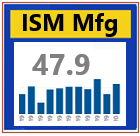
ISM A gauge on the U.S. manufacturing sector fell last month, indicating that economic activity in the space is close to contracting. The Institute for Supply Management said Monday that its manufacturing PMI fell to 50.9 in September from 52.8 in August — barely in expansion territory. A print below 50 indicates contraction, and one above that level points to an expansion.
ISM Manufacturing Index shows U.S. manufacturing expansion slowed in September 2022. September ISM Manufacturing PMI: 50.9 vs. 52.4 expected and 52.8 prior. With the index still, above 50, the U.S. manufacturing sector continued to expand in September, but the pace was the slowest since the pandemic recovery began, the Institute for Supply Management said.U.S. manufacturing activity grew at its slowest pace in nearly 2-1/2 years in September as new orders contracted amid aggressive interest rate increases from the Federal Reserve to cool demand and tame inflation. The Institute for Supply Management (ISM) survey on Monday also showed a measure of manufacturing employment contracted last month for the fourth time this year. A gauge of inflation at the factory gate decelerated for a sixth straight month. Manufacturing PMI falls 1.9 points to 50.9 in September. New orders, employment measures contract. Price pressures at factories, supply bottlenecks easing. Construction spending falls 0.7% in August.
ADP
Businesses added 208,000 jobs in September, better than expected, ADP reports. Businesses added 208,000 jobs for the month, better than the 200,000 Dow Jones estimate and ahead of the upwardly revised 185,000 in August, according to ADP. Trade, transportation and utilities saw a jobs gain of 147,000, while professional and business services and education and health services also posted large increases. ADP National Employment Report: Private Sector Employment Increased by 208,000 Jobs in September; Annual Pay was Up 7.8%. The jobs report and pay insights use ADP's fine-grained anonymized and aggregated payroll data of over 25 million U.S. employees to provide a representative picture of the labor market. The report details the current month's total private employment change, and weekly job data from the previous month. ADP's pay measure uniquely captures the earnings of a cohort of almost 10 million employees over a 12-month period.
Trade Deficit
In other economic news Wednesday, the U.S. trade deficit fell again, declining to $67.4 billion in August, its lowest level since May 2021.
ISM Service
Also, the ISM services index edged lower to 56.7% but still represented expansion in the sector. The reading was better than the 56% estimate.
JOLTS
The number of job openings plunged by more than a million in August, providing a potential early sign that the massive U.S. labor gap is beginning to close. Available positions totaled 10.05 million for the month, a 10% drop from the 11.17 million reported in July, according to a Bureau of Labor Statistics release Tuesday. That was also well below the 11.1 million FactSet estimate and was the biggest one-month decline since April 2020 in the early days of the Covid pandemic. The number of hires rose slightly, while total separations jumped by 182,000. Quits, or those who left their jobs voluntarily, rose by 100,000 for the month to 4.16 million. The Job Openings and Labor Turnover numbers are watched closely by the Federal Reserve, which is trying to reverse runaway inflation through a series of five interest rate increases this year that thus far have totaled 3 percentage points. One primary area of interest for the central bank has been the ultra-tight labor market, which had been showing about two job openings for every available worker. That ratio contracted to 1.67 to 1 in August. The job market has been a primary driver of inflation, as the outsized demand for the scarce labor pool has helped drive up wages sharply. Average hourly earnings rose 5.2% over the 12-month period through August. But adjusted for inflation, real earnings actually declined 2.8%.
Employment
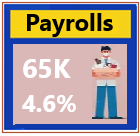
Payrolls rose 315,000 in August as companies keep hiring. Nonfarm payrolls rose by 315,000 jobs in August, just below the Dow Jones estimate for 318,000. The unemployment rate climbed to 3.7%, two-tenths of a percentage point higher than expectations. Wages also rose, with average hourly earnings up 5.2% from a year ago, slightly lower than the estimate. The biggest sector gainers were professional and business services, health care and retail. Nonfarm payrolls rose solidly in August amid an otherwise slowing economy, while the unemployment rate ticked higher as more workers rejoined the labor force, the Bureau of Labor Statistics reported Friday. The economy added 315,000 jobs for the month, just below the Dow Jones estimate for 318,000 and well off the 526,000 in July and the lowest monthly gain since April 2021. The unemployment rate rose to 3.7%, two-tenths of a percentage point higher than expectations, largely due to a gain in the labor force participation rate to 62.4%, tied for the highest level of the year. A broader measure of unemployment that includes discouraged workers and those holding part-time jobs for economic reasons climbed to 7% from 6.7%. Wages continued to rise, though slightly less than expectations. Average hourly earnings increased 0.3% for the month and 5.2% from a year ago, both 0.1 percentage point below estimates.
Markets whiplashed last week, starting with a relief rally that pushed the S&P 500 up more than 5% in its largest two-day gain since 2020. That rally unwound when jobs data came in stronger than expected, signaling further rate hikes.
Geoploitical
Inflation is running near its fastest pace in more than 40 years as a combination of a supply-demand imbalance, massive stimulus from the Fed and Congress and the war in Ukraine has sent the cost of living soaring. However, the labor market has held strong even as other aspects of the economy have weakened. Housing in particular is likely in a recession.
MBA Purchase Applications
mmmmm
PMI Manufacturing Final
mmmm
Construction Spending
U.S. construction spending fell by the most in 1-1/2 years in August 2022, pulled down by a sharp decline in outlays on single-family homebuilding amid surging mortgage rates. The Commerce Department said on Monday that construction spending dropped 0.7% in August, the largest decline since February 2021, after decreasing 0.6% in July. Economists polled by Reuters had forecast construction spending would slip 0.3%. Construction spending increased 8.5% on a year-on-year basis in August.
Factory Orders
U.S. factory orders flat in August, as expansion in the manufacturing sector slows. Orders for manufactured goods were flat in August, the Commerce Department said Tuesday. The unchanged reading was in line with forecasts of economists surveyed by the Wall Street Journal..
PMI Composite Final
The S&P Global US Composite PMI increased to 49.3 in September 2022 from 44.6 in the previous month, pointing to a softer decline in private sector business activity, a preliminary estimate showed. Service output contracted at a slower rate, while manufacturers continued to register a slight fall in production. New orders rebounded despite a continued decline in export orders, while employment rose. On the price front, input cost inflation eased to the slowest since the start of 2021, but remained high overall on the back of interest rate hikes and material and wage increases. Looking ahead, business confidence picked up to a four-month high and was only just below the series trend on hopes of further upticks in new orders and the acquisition of new customers.
Jobless Claims
Hurricane Fiona helps to boost U.S. weekly jobless claims. The number of Americans filing new claims for unemployment benefits increased by the most in four months last week, but the labor market remains tight even as demand for labor is cooling amid higher interest rates. Some of the larger-than-expected jump in jobless claims reported by the Labor Department on Thursday was blamed on Hurricane Fiona, with filings surging in Puerto Rico, which was ravaged by the storm in the second half of September. Weekly jobless claims increase 29,000 to 219,000. Continuing claims rise 15,000 to 1.361 million. Announced job cuts jump 46% to 29,989 in September.
Wholesale Trade
mmmm
Consumer Credit
U.S. Consumer Borrowing Has Reached Record Highs. American consumers are more indebted than ever. The just recently released Federal Reserve Consumer Credit-G.19 report shows that U.S. consumer credit outstanding has reached historic levels; outstanding consumer credit is now at $4.7 trillion. In August, consumer credit increased at a seasonally adjusted annual rate of 8.3 percent. The previous rise in July had been 6.%. These current levels of consumer debt show that the Federal Reserve raising rates has not slowed down consumer borrowing. While consumer credit declined in the years immediately after the 2007 – 2009 financial crisis, since the second quarter of 2011 until the second quarter of this year, consumer credit outstanding has increased by 90%.
Fixed Mortgage Rates
mmmm |